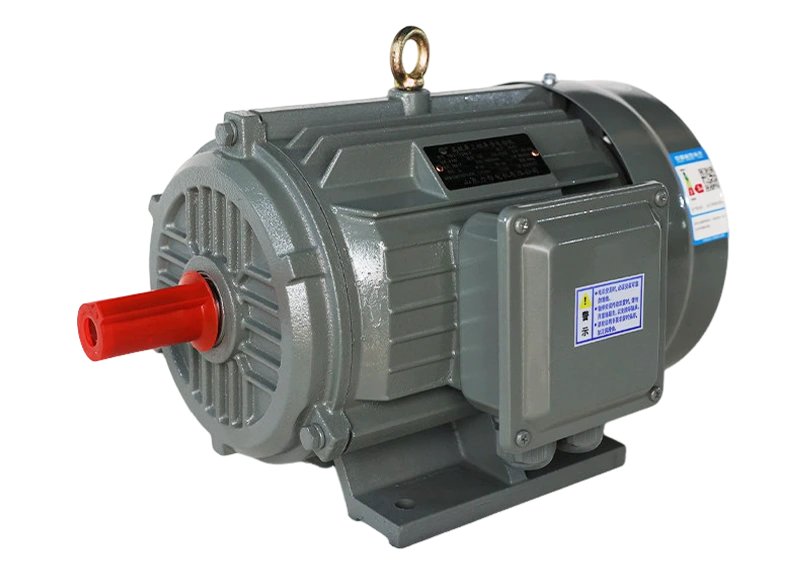
The insulation rating of a three-phase asynchronous motors refers to the heat resistance rating of the insulation material used in the motor windings. It determines the motor’s maximum allowable operating temperature and directly affects its overload capacity, service life, and operational stability. Standard products typically feature Class F insulation, which can be upgraded to Class H, while some basic models use Class B insulation. The specific parameters and their effects are as follows:
Class B insulation: Maximum allowable operating temperature of 130°C, with a winding temperature rise limit of 80K. Suitable for light loads, short-duration operation, and environments with lower ambient temperatures. The insulation materials are less expensive, making the motor more affordable; however, its overload capacity is weaker. Prolonged operation at high temperatures can lead to insulation aging, with a service life of approximately 5–8 years.
Class F insulation: Maximum allowable operating temperature of 155°C, with a winding temperature rise limit of 105K. This is currently the mainstream international insulation class, offering excellent heat resistance and strong overload capacity. It is suitable for prolonged continuous operation and high ambient temperature conditions. The insulation layer ages slowly, ensuring extremely high motor stability. with a normal service life of 10–15 years. It is the preferred standard for export markets, and over 90% of our three-phase induction motors utilize Class F insulation, balancing cost-effectiveness and durability.
The insulation class directly determines a motor’s high-temperature resistance. If a motor operates for an extended period at temperatures exceeding its insulation class, the insulation material will rapidly become brittle and crack, leading to winding short circuits and burnout, rendering the motor completely unusable. Our Class F insulation motors utilize imported insulation varnish and high-strength winding wire, processed through a vacuum impregnation and drying process. Their insulation performance far exceeds national standards. Even during continuous operation in high-temperature environments above 40°C, the winding temperature can be maintained within a safe range, completely resolving customers’ concerns about high-temperature damage and reducing equipment maintenance and replacement costs.

888 Huaihe West Road, Huangdao District, Qingdao City, Shandong Province
Copyright © 2025 by Shandong Longchi Electric Motor Co., Ltd. All Rights Reserved