A three-phase asynchronous motor is a vibration-generating device that integrates a power source with a vibration source. Its structural analysis can be broken down into four core modules: the stator, the rotor, the eccentric block system, and the support and protective structure. These modules work in concert to produce vibration:
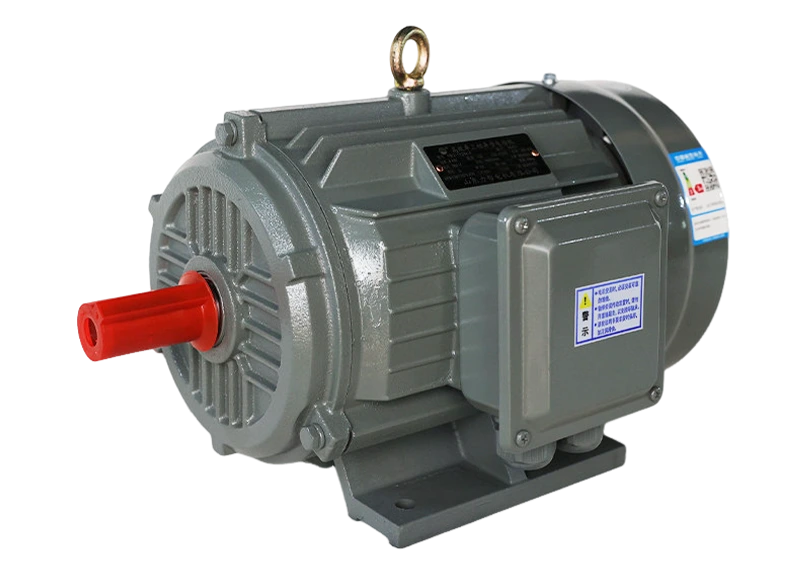
I. Stator: The Core of Rotating Magnetic Field Generation
The stator is the stationary part of the motor, consisting of the frame, the stator core, and the stator windings:
Frame: Constructed of cast iron or steel plate, it provides mechanical support and secures all components. Its surface is cast with cooling fins to enhance heat dissipation efficiency.
Stator Core: Laminated from 0.3–0.5 mm thick silicon steel sheets, it features evenly spaced slots punched into the inner circumference to accommodate the stator windings, thereby reducing eddy current and hysteresis losses.
Stator Windings: Composed of three symmetrical windings spaced 120° apart in electrical angle. When three-phase AC current is applied, they generate a rotating magnetic field and serve as the key component for power conversion in the motor.
II. Rotor: Carrier of Induced Current and Electromagnetic Torque
The rotor is the rotating part of the motor, separated from the stator by an air gap. It is classified into two types: squirrel-cage and wound:
Squirrel-cage Rotor: Aluminum or copper bars are embedded in the slots of the rotor core, with end rings short-circuiting the ends to form a “squirrel-cage” structure. It features a simple design and is easy to manufacture, making it a commonly used type in industry.
Wound Rotor: It contains coil windings similar to those in the stator and is connected to an external resistor via slip rings. This allows for adjustment of starting performance and speed, but due to its complex structure, it is less commonly used.
III. Eccentric Weight System: The Direct Source of Excitation Force
Adjustable eccentric weights are mounted at both ends of the rotor shaft, serving as the core component for generating vibration:
Structure: Consists of a fixed excitation block and an adjustable excitation block; the excitation force is continuously adjustable by altering the angle between the two.
Principle: When the motor rotates, the eccentric blocks generate centrifugal force, the magnitude of which is determined by the formula F = m × r × ω (where m is the mass of the eccentric block, r is the eccentricity, and ω is the angular velocity).
Adjustment Method: The excitation force is adjusted by rotating the adjustment block to change the angle between the two blocks. A larger angle results in a stronger excitation force, and the direction can be adjusted to horizontal, vertical, or inclined output by changing the installation angle.
IV. Support and Protection Structure: Ensuring Stable Operation
Bearing System: Features a combination of end caps, inner bearing covers, retaining rings, and shaft sleeves. Some models are equipped with dust-proof structures, utilizing a waist-shaped filter screen and L-shaped sliding sleeve to achieve self-cleaning during vibration.
Protection Rating: For example, the MVE series has an IP65 protection rating, preventing dust and moisture ingress and extending equipment lifespan.
Lifting Structure: Features a threaded sleeve and screw combination design for easy on-site installation and maintenance.

888 Huaihe West Road, Huangdao District, Qingdao City, Shandong Province
Copyright © 2025 by Shandong Longchi Electric Motor Co., Ltd. All Rights Reserved