The braking methods for three-phase induction motors are primarily divided into two categories: mechanical braking and electrical braking. Electrical braking is further subdivided into three typical methods: reverse-connection braking, energy-dissipating braking, and regenerative braking (also known as regenerative braking).
II. Mechanical Braking
1. Electromagnetic Brake
Working Principle:
Powered State: When the electromagnet coil is energized, it attracts the armature, and the push rod compresses the spring. At this point, the brake shoes separate from the brake drum,
allowing the motor to rotate freely.
De-energized State: The spring returns to its original position, actuating the lever mechanism, causing the brake shoes to clamp onto the brake drum and generate frictional braking force.
Technical Points:
Must be equipped with a mechanical interlock device to ensure immediate brake activation upon power loss
Asbestos-rubber composite material is recommended for brake shoes; the coefficient of friction must be maintained within the range of 0.35–0.45
Application Scenarios:
Fall protection systems for lifting equipment
Emergency braking devices for winches
Elevator safety braking systems
Precautions:
Regularly inspect brake shoe wear (replace if worn beyond one-third of original thickness)
Adjust spring preload quarterly to maintain stable braking torque
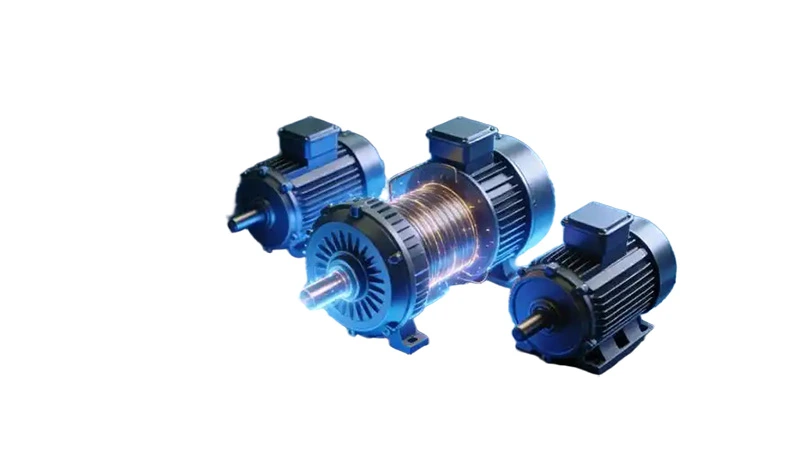
III. Electrical Braking
1. Reverse-Phase Braking
Technical Principle:
1. Switch the power phase sequence to reverse the direction of the rotating magnetic field
2. When the rotor cuts through the reverse magnetic field, the slip rate s > 1
3. A reverse electromagnetic torque is generated (torque is proportional to the slip rate, T∝s)
Key Parameters:
Formula for calculating the current-limiting resistor value: R = (0.1–0.2)U_N/I_N
Braking current must be controlled within 3–4 times the rated current
Typical Applications:
Rapid braking of lathe spindles
Emergency stop control for milling machine tables
Periodic braking of stamping equipment
Safety Regulations:
A speed relay must be installed (recommended trip speed: 100–120 r/min)
Continuous braking must not exceed 3 times per hour
2. Regenerative Braking
Procedure:
1. First, disconnect the AC power supply
2. Connect the DC power supply (voltage set to 15–20% of the rated voltage)
3. Adjust the DC current to 3–4 times the no-load current
Performance Characteristics:
Braking torque is directly proportional to speed (T∝n)
Braking force decreases significantly in the low-speed range (speeds below 15% of rated speed)
Applications:
Braking requirements for precision grinding machine spindles
Positioning and stopping control for automated production lines
Servo system shutdown operations
Precautions:
A three-phase bridge rectifier circuit is recommended for the DC power supply
Braking time should not exceed 30 seconds
3. Regenerative Braking
Energy Conversion Mechanism:
When the motor speed n exceeds the synchronous speed n_0:
Slip rate s < 0
The motor enters generator mode
Mechanical energy is converted into electrical energy and fed back to the grid
Energy-saving benefits:
Energy savings of 40–60% can be achieved during crane descent operations
Energy recovery rates for subway braking are approximately 25–35%
System configuration:
A bidirectional converter (using IGBT modules) must be installed
A harmonic filter must be installed on the grid side

888 Huaihe West Road, Huangdao District, Qingdao City, Shandong Province
Copyright © 2025 by Shandong Longchi Electric Motor Co., Ltd. All Rights Reserved