Today, let’s discuss why customers should choose reputable manufacturers when selecting explosion-proof motors. Not
only must the quality be up to standard, but the service must also be reliable—the ability to resolve customer issues is
the key. threephaseasynchronousmotors.com
When selecting explosion-proof motors, customers should focus on four key points: explosion-proof rating, operating environment, installation compatibility, and regulatory compliance. By avoiding common pitfalls,
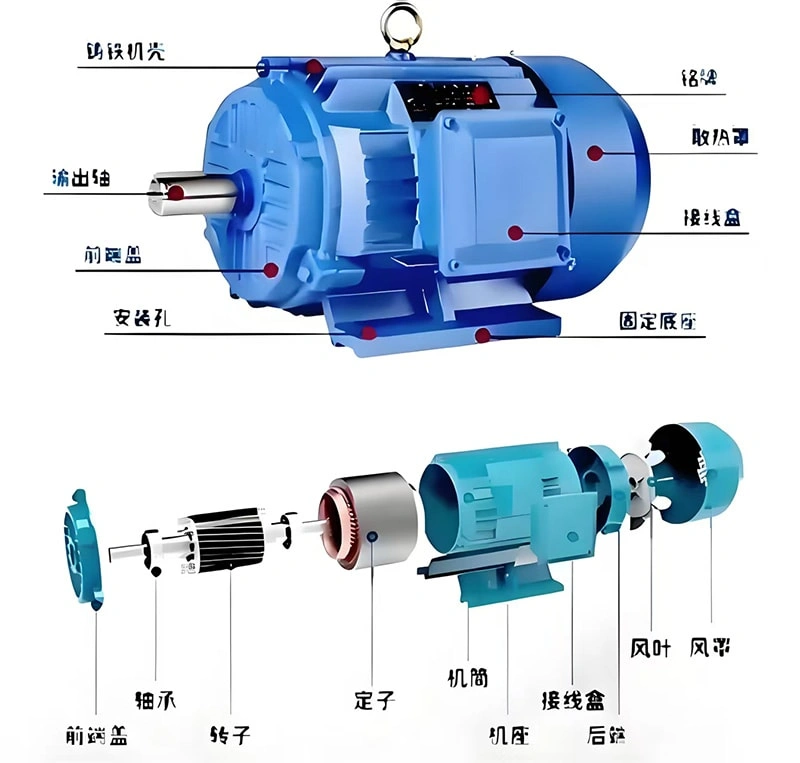
you’ll make the right choice. Below, we’ve compiled a practical checklist that’s easy to understand and convenient for recommendations:
I. First, assess the operating environment: This determines the appropriate explosion-proof rating
1. Presence of flammable or explosive gases/dust - Gas environments: Primarily choose flameproof type Ex d - Dust environments: Select dust-proof explosion-proof (Ex tD) - Mixed gas and dust environments: Select a combined-type explosion-proof motor
2. Temperature of hazardous substances - Check temperature classes T1–T6 - Lower temperatures indicate greater safety; generally prioritize T4 and above
3. Hazardous area classification - Zone 0/Zone 20: Continuous hazard → Use a higher-level explosion-proof rating - Zone 1/Zone 21: Occasional hazard → Standard flameproof type - Zone 2/Zone 21: Short-term hazard → Increased safety or intrinsically safe types may be selected
II. Understanding Explosion-Proof Markings (Most Often Overlooked by Customers)
Example of a complete marking: Ex d IIB T4 Gb - Ex: Explosion-proof - d: Flameproof type (most common) - IIB: Gas group (IIA < IIB < IIC) - Hydrogen, acetylene, carbon disulfide → Must be IIC - Regular gasoline, alcohol, propane → IIB is sufficient - T4: Surface temperature ≤ 135°C - Gb: Equipment protection level
Simple rule of thumb: IIC is more expensive than IIB, but safer and suitable for a wider range of gases.
III. Power, Voltage, and Mounting Type Must Match the Equipment
1. Power, Speed, Voltage
Must match the original motor/equipment; do not focus solely on explosion-proof certification while ignoring these parameters
2. Mounting Type (Frame Size)
B3, B5, B35, etc. — Incorrect flanges or mounting feet will prevent installation
3. IP Protection Rating
For outdoor, humid, or dusty environments, IP55 or higher is recommended.
IV. Qualifications and Certifications (Customers are most concerned about whether the product will pass inspections)
1. Must have a National Explosion-Proof Qualification Certificate
2. Must have a Production License and 3C Certification (for the domestic market)
3. For export: ATEX (EU) and IECEx (International)
4. Reject products without proper certification, OEM-branded items, and expired certificates
V. Additional Details on Operating Conditions - Humid, corrosive environments: Select corrosion-resistant explosion-proof motors - Frequent starts, heavy loads: Select a higher insulation class, such as Class F - Variable frequency drive (VFD) use: Must select dedicated VFD explosion-proof motors; standard explosion-proof motors are prone to failure
VI. Simple Selection Guidelines for Customers
1. Check the ambient gas composition and select IIB/IIC
2. Check the temperature and select T4 or higher
3. Check the zone and select the appropriate explosion-proof type
4. Verify power, voltage, and installation dimensions
5. Check that all explosion-proof certification documents are complete

888 Huaihe West Road, Huangdao District, Qingdao City, Shandong Province
Copyright © 2025 by Shandong Longchi Electric Motor Co., Ltd. All Rights Reserved